Our ambition
Develop a fast-scanning broadband and high-resolution optical instrument capable of detecting trace amounts of gaseous species using the Fourier transform spectroscopy technique.
PROJECT FACTS
Programme Component Operator:
- Wroclaw University of Science and Technology
Programme Component Partners:
- Military University of Technology
- VIGO Photonics S.A.
- Swiss Federal Institute of Technology Zürich
Duration of the project: 1.10.2025 – 30.09.2028
Total project cost: 1 035 657.07 CHF / 4 644 714.85 PLN
Total project funding: 973 860.21 CHF / 4 367 568.28 PLN
Funding institution: National Centre for Research and Development (NCBR)
Project number: SPPW/SWIRLS/0019/2024-00
Contest: Swiss-Polish Cooperation Program CALL 2024






Technical Description
Utilizing chip-based semiconductor lasers for spectroscopic environmental monitoring
In the air we breathe, dozens of chemical compounds are floating around — from completely harmless ones to those that can negatively affect human health and the environment. Detecting them quickly and with high accuracy requires tools capable of “looking into” the unique optical signatures of these substances. This is precisely the focus of the SWIRLS project (Sensitive Wideband Infrared Laser Spectroscopy), which aims to create a new class of instruments for exceptionally sensitive, wideband laser spectroscopy.
Most volatile chemical compounds — including many toxic gases and pollutants — have characteristic absorption lines in the mid‑infrared (MIR) range. These can be thought of as a set of “barcodes,” each molecule revealing its identity through its spectral fingerprint. With a precision laser operating in the right part of the spectrum, it becomes possible to detect even extremely small amounts of a given substance.
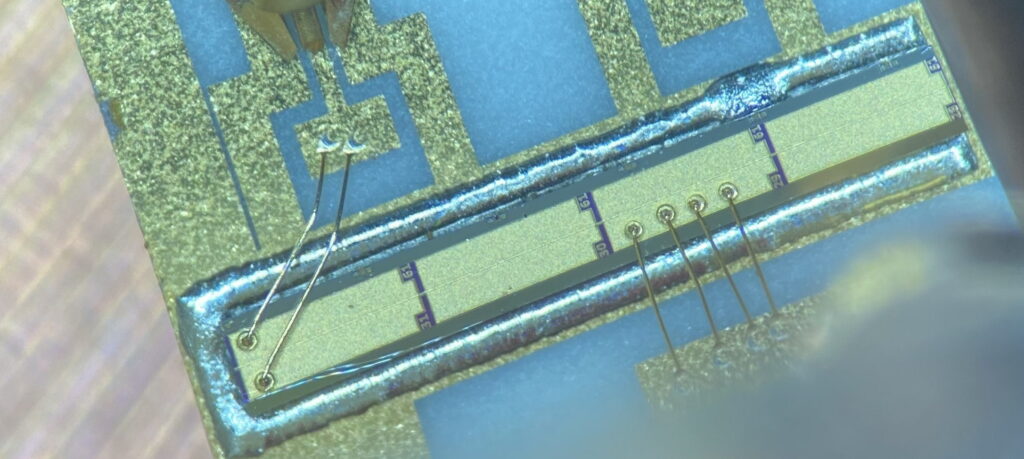
To achieve the sensitivity required for such measurements, SWIRLS uses quantum cascade lasers (QCLs). These are among the most advanced light sources in the MIR range, known for their stability and their ability to operate at many different wavelengths. Yet the project takes this even further — the QCLs will be additionally modulated using microwaves, enabling a wide measurement bandwidth and very high resolution, while significantly speeding up spectral scanning.
A fast, wideband laser is only half the solution. Equally important is a detector capable of capturing subtle changes in light after it passes through the analyzed gas. SWIRLS will employ new detectors based on type‑II superlattices — structures composed of extremely thin layers of semiconductor materials. Such superlattices can record MIR signals with exceptionally high sensitivity while operating faster than traditional detectors.
AMBITION
______
By combining advanced microwave‑modulated QCLs with superlattice detectors, SWIRLS aims to develop a system that:
• rapidly analyzes gas mixture composition,
• covers a wide spectral range,
• delivers precise and detailed absorption spectra,
• enables the detection of even trace concentrations of harmful substances.
Supported by the Swiss Contribution to reducing economic and social disparities in the EU and from the state budget through the National Centre for Research and Development.